


Portrait Painting for the Fallen of Swords of Iron and for the Murdered Civilians: The Portrait That Gives the Face Back
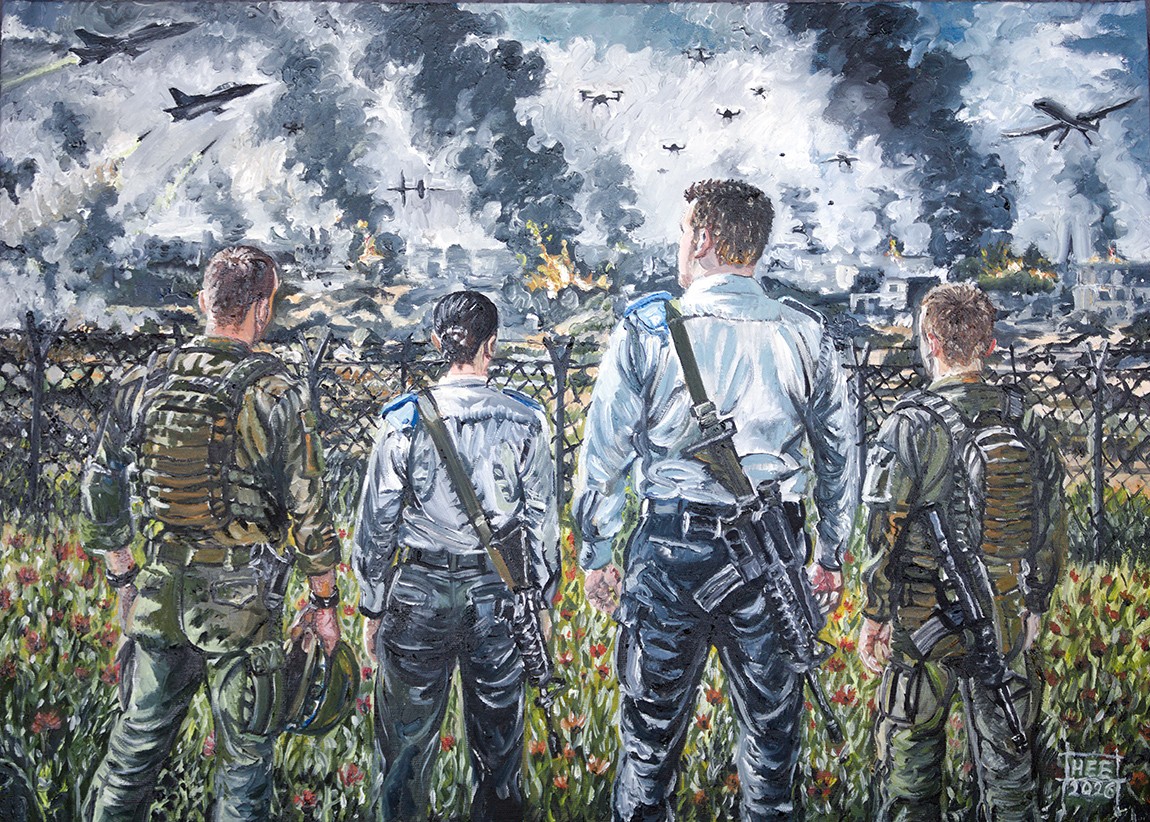
I painted four fighters standing in a field of red flowers, their backs to the viewer, facing a horizon filling with smoke. Their faces cannot be seen, because they served in classified units. What is missing there says exactly what I want to write about here. A portrait painting is the place where a person is conveyed through his face. When the face is absent, a figure remains. When the face is given, a person remains.
The War That Has Not Ended
On the Sabbath of Simchat Torah, 7 October 2023, some two thousand Hamas terrorists broke through the border fence and infiltrated Israel by land, sea and air. They moved toward the communities of the south and toward the Nova Music Festival, held near Kibbutz Re'im. Across the area they murdered people and entire families in their homes and in the places they tried to flee to. More than 1,200 murdered victims have been identified. 251 men, women and children were taken hostage into Gaza.
Israel went to war: Swords of Iron. On 27 October 2023 the ground maneuver in the Strip began. A day after the massacre, Hezbollah opened fire from the north on the communities of the Galilee. In September 2024 Operation "Northern Arrows" was launched against Lebanon, in the course of which Hassan Nasrallah was eliminated. The ceasefire with Lebanon was signed on 26 November 2024. From Yemen the Houthis launched missiles and drones. Iran attacked Israel directly twice: some 120 ballistic missiles and some 170 armed drones in April 2024, some 200 ballistic missiles in October 2024. In June 2025 Israel launched Operation "Rising Lion" against the Iranian nuclear program. On 28 February 2026 Operation "Roaring Lion" was launched, together with the Armed Forces of the United States. On every one of these fronts people fell. To every one of them names were added.
In Gaza a ceasefire was signed in October 2025, and the IDF has operated along the Yellow Line ever since. In January 2026 the last of the hostages was returned. All of them came home. In southern Lebanon the IDF operates in the Security Zone. As these words are written, the war has not ended. This article was born inside it.
A Pain Beyond Measure, and the Request That Rises From It
Since 7 October many families in Israel have carried a loss that language struggles to hold. Parents who walked a child to his enlistment and were given the news at the door. Brothers and sisters left alone where there had been two. Children growing up into a name that remembrance now travels with. This pain is private to the end. It is also national. The person who was cut down belonged to his house, and became one of ours.
Out of the pain rises a request, simple and enormous: that the face remain. Not a photograph on a phone, swallowed among thousands of others, but a figure hanging on a wall at home. A figure you can stand in front of. A figure through which grandchildren not yet born will know the person they will never meet. Human beings have carried this request for thousands of years, and history has given it one answer: a portrait painting.
When the Face Is Resistance to Erasure
The Yad Vashem Art Museum presented an exhibition called Last Portrait: Painting for Posterity. On display were nearly two hundred portraits by twenty-one artists who strove to immortalize their friends in the ghettos and the camps. Yad Vashem describes how, with a few lines of pencil or charcoal on paper, the artists managed to breathe life into the images of people in the shadow of death. By reproducing each individual's facial features, the museum writes, they gave him back his soul, the very quality the Nazis sought to eliminate. The museum is explicit that this was no isolated case and nothing incidental: the phenomenon occurred simultaneously in dozens of ghettos and concentration camps.
What rises from the exhibition as a whole, in the museum's words, is that the artists memorialized their brethren as they saw them, and themselves as they would like to be remembered by future generations: not as victims, but as human beings. Each portrait binds together three stories, Yad Vashem writes — that of the subject, that of the artist, that of the work itself. At the close the museum turns to the Jewish philosopher Emmanuel Lévinas, who survived the Holocaust as a French soldier in German captivity. Lévinas writes of "this face of the other, without recourse, without security, exposed to my look and in its weakness and its mortality". It is also, in his words, the face that orders me: thou shalt not kill.
Two Thousand Years of the Same Answer
Yad Vashem itself sets these portraits in one line with artwork from Pompeii and from Fayum. The Fayum portraits are funerary portraits of the Roman period, discovered in Egypt. In both, the museum writes, we encounter faces that have survived destruction and the tribulations of history. The Metropolitan Museum holds one of them, the portrait of a boy named Eutyches, from the second century of the common era. It was made, the museum explains, to be included in the wrappings covering his mummified body. The boy looks calmly at the viewer. The portrait is remarkably lifelike. Across the neck of his white tunic a Greek inscription gives his name. Two thousand years ago people already understood that the way to hold on to someone who is gone runs through his face.
States arrived at the same conclusion in their own way. Toward the end of the First World War the British government commissioned a group of paintings as a memorial to the dead. The central painting was commissioned from John Singer Sargent, one of the great society portraitists of his day. The paintings were meant for a memorial gallery to be built specially for them, the Hall of Remembrance. The hall was never built. The project ran out of time and money. The collection passed to the Imperial War Museum, which holds it to this day. When the central painting was first shown to the public in May 1919, its realism reportedly moved some people to the point where they felt physically ill.
Not Only for Those Who Fell
Not everyone who goes out to war falls in it. Not every war portrait is the portrait of a dead man. In the First World War the surgeon Harold Gillies set up a center for facial reconstruction at Queen Mary's Hospital in Sidcup. The patient case files relate to over 2,500 soldiers who underwent surgery there. The team Gillies assembled included surgeons, nurses and artists. Aware of the social stigma attached to facial injury, he sought to return the wounded man to the face he had before. He sometimes called upon artists to paint color portraits of the wounded soldiers and take casts of their faces. Among them was Henry Tonks, who trained as a surgeon before he became a painter. His pastel portraits are preserved to this day in the Hunterian Museum collection.
This deserves to be said plainly to anyone who came back from this war wounded in body or in mind. A portrait is not reserved for the dead. A fighter who returned from battle. A person who came out of captivity. An evacuee who came back to a burnt house. A civilian who survived the attack of 7 October. Each of them has a face that has been through something there are no words for. A hand-painted portrait is one of the ways of saying that he is here, that he is seen, that he is not forgotten.
The Wave That Began in Swords of Iron
In this war the movement Yad Vashem described returned in Israel: people who know how to draw began to draw faces. Many illustrators and artists started offering bereaved families a personal act of remembrance, as volunteers. Lea Naiditch created the illustrated remembrance project "And Life Will Yet Return to Bloom", in which she illustrates portraits of the fallen on request and works dried flowers into them. Of the work she said: "When I illustrated them line after line, I felt as though I were truly touching them, stroking their faces and embracing them."
At Bezalel a project arose called A Portrait in Their Memory, for the remembrance of the men and women who fell in the Swords of Iron war. Students of the academy brought together a team of more than twenty professional illustrators, who prepared personal portraits following requests from bereaved families. Keren Pargo of Kibbutz Ma'ayan Zvi painted Maj. Avraham Hovelashvili, who fell in battle, and afterwards invited women to embroider with her onto portraits she had prepared. Itai Mordechai, who draws in digital pencil, asks to know who the person was and how he fell, so that he can build the portrait in his mind before the work begins.
Other forms of remembrance touch the same place. Yifat Paar's photography exhibition "A Last Embrace" was shown on the plaza of the National Institutions in Jerusalem. She looked at loss through the eyes of bereaved parents, and in every photograph the parent is holding a picture of his child. At the illustration exhibition "Blue and White Heroes" a room was devoted to the work of artists murdered on 7 October or killed in the war.
Why a Memorial Portrait Is a Different Thing
A good many memorial portraits hang in my galleries. A grandmother who died at a ripe old age. A father. A beloved dog who was part of the household for years. A memorial portrait of that kind rests on a life that was completed, and comes to sum it up: the face that time ploughed, the look that saw grandchildren, the hands that did a great deal. The commission comes out of gratitude. Even when the loss burns, there is an order in it that the soul knows how to read. Old age comes after maturity. The parting comes at the end of a life.
A portrait painting for a fighter who fell in Swords of Iron, or for a civilian murdered on 7 October, is not the same thing. To my mind it should not even be called by the same name. Three differences stand between them, and each one changes the painting itself.
The first, that there is nothing to sum up. There is no completed life here, but a life cut off in the middle of the sentence. The portrait sums up nothing. It stands against the severance and says: here was a person, this is how he looked, this is how he gazed, this is how he smiled in the photograph taken that evening.
The second, that the photograph is chosen out of very little. A family commissioning a portrait of a grandfather chooses from an album of eighty years. A family that lost a son at twenty chooses from the little it has. Sometimes several photographs have to be joined into one painting, or a figure built out of material that is not quite enough. The work is done differently.
The third, that the fallen belongs to the public as well. His name is read out at a ceremony, engraved on a monument, set down in a long list. That is a great honor and he deserves it. There is something painful in it too: the person becomes a name inside a list. A painting in the family's living room does the opposite. It brings him back from the list to the house, from the first name to the face, from national heroism to the child who once sat at that table.
How This Work Is Done With Me
I have painted commissioned portraits since 2005, and I hold a master's degree in art history from the University of Haifa. Writing about portraits of rabbis and tzaddikim, I said that every project lets me learn something more about human beings. Work of this kind sharpens my sensitivity and my identification with the human story, and I find myself connecting again to the feelings of the people who commission it. In a portrait of someone who fell or was murdered, all of this is true sevenfold.
The work is done from a photograph you send me by email, by WhatsApp or by post. It is best to choose a picture at high resolution, because in a portrait the small details are the whole thing, and a file that has been through WhatsApp loses quality. If no single photograph is enough, several pictures can be joined into one painting, including pictures whose subjects were never photographed together. In oil on canvas I work in the traditional European technique of layered paint, which gives the portrait a depth and a finish that hold for years. While the work is in progress I can send you photographs of the stages. At the end I send a photograph of the portrait, and adjustments can be asked for.
A hand-painted portrait does not bring back the one who is gone. Neither does it heal. What it does is place in the house a face that can be looked at, spoken to, shown to a guest who never had the chance to know him. In the portrait traditions I examined, from Europe to East Asia, the same act returns: a person paints a person so that he will not disappear.
In the painting I opened with there are no faces. In a portrait of someone who fell, the face is the whole point. If you ask me to paint your loved one, I will come to it with all the respect and all the feeling the matter demands.