


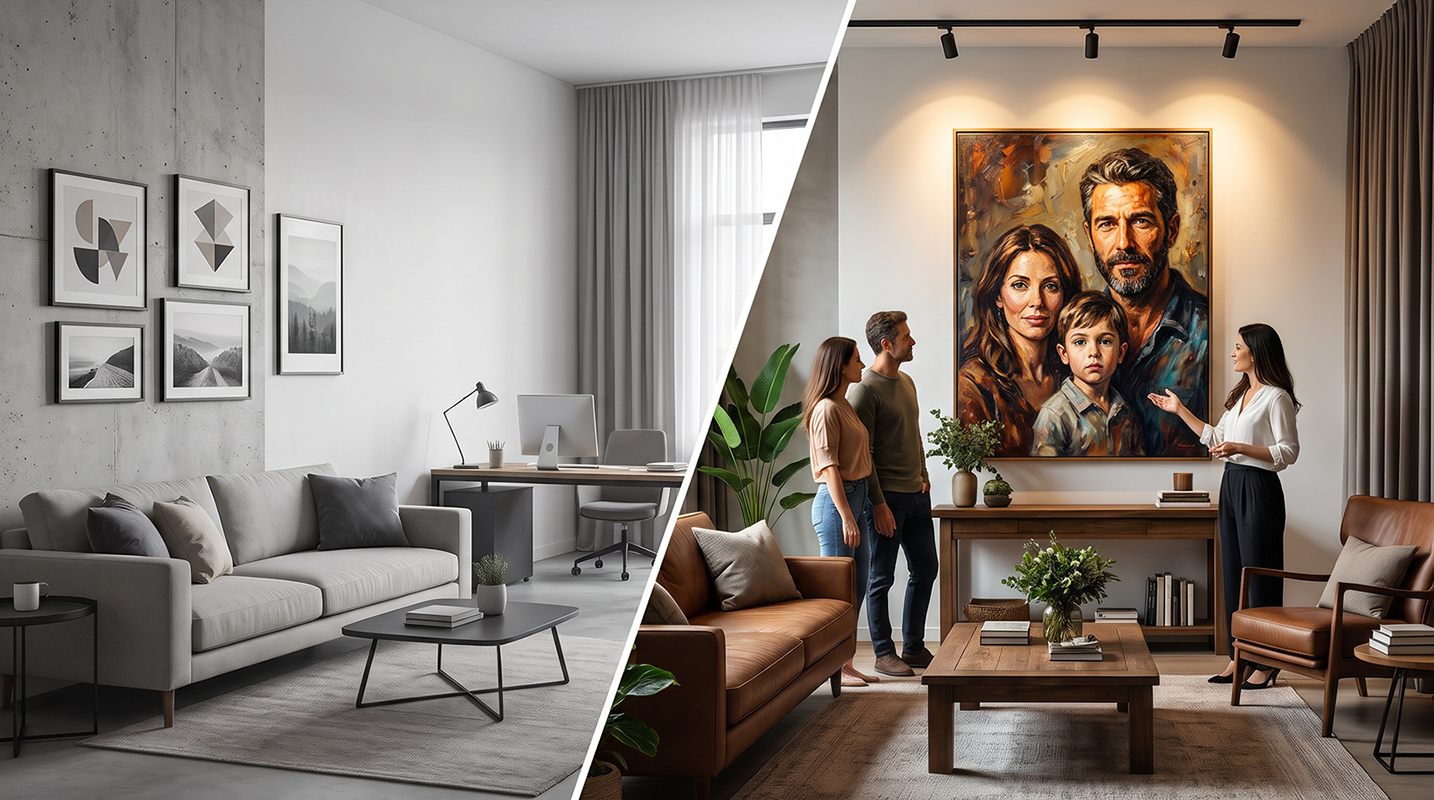
The Psychology of the Wall: From Catalog Interior Design to a Singular Space Through Commissioned Portraits
Some rooms have nothing wrong with them. The sofa agrees with the rug, the pendant hangs at a measured height, the wall color was chosen from a careful gradient. Everything is correct. And yet a person can walk into such a room and sense that it belongs to nobody. That room appears in many other homes, because its pieces were chosen from a range that stood open to everyone who walked into the same store.
The point where a room stops being a catalog and starts being a home usually sits on one wall. A portrait painting in interior design is an element that cannot be copied into another space, because it depicts particular people who live or work there. This tradition of commissioning runs far longer than the profession of interior design itself. The museum records below show one thing: putting a commissioned portrait painting on a wall is a decision about a space, not about an object.
Interior design is not decoration, by the profession's own account
The Council for Interior Design Qualification, the body behind the NCIDQ credential, defines the field as "a distinct profession with specialized knowledge applied to the planning and design of interior environments that promote health, safety, and welfare while supporting and enhancing the human experience." A separate body publishes the professional standards against which degree programs are assessed. That credential is a condition of licensure in numerous U.S. states and Canadian provinces.
The next sentence of that same definition speaks directly to the heading above this article. It places the field, in its own words, "upon design and human behavior theories and research," and has designers applying evidence-based methodologies. So the psychology here is not a literary flourish added to a title. It sits in the profession's own definition, in its second sentence.
The same page lists what the work covers: planning the space; selecting finishes, furniture and equipment; designing lighting and acoustics. Read that list closely and something is missing from it. Art on the wall is not among the items named. That is a statement about the contents of a list, and anyone can check it.
This is where the quiet advantage sits. A designer governs the envelope of a room with real expertise, and the surface that most directly carries who the occupants are falls outside the enumerated scope. A homeowner who brings a commissioned portrait to the table is not arguing about taste. They are filling a gap the profession's own list leaves open.
Who invented interior design, and in which room
The Cooper Hewitt, Smithsonian Design Museum writes of Elsie de Wolfe that she "invented" the profession of interior decorating. The museum sets the word in quotation marks, and it is kept that way here.
Her years on the stage ended as word spread of her taste, which she put to work advising women in her social circle to clear out Victorian clutter and decorate with a leaner elegance. In 1905 she took on the interiors of New York's Colony Club, which the museum describes as "the first private social club for women". Its founders were Elizabeth Marbury, Anne Vanderbilt, Anne Tracy Morgan and Florence J. Harriman. The museum states plainly that the decoration of that club established her immense reputation. Her book The House in Good Taste appeared in 1913.
Follow the sequence. The profession attached itself to her name through one commission, in one room, for a particular group of people. That logic still sits at the center of a commissioned portrait painting today.
The wall came before the catalog: a portrait commissioned for a named hall
Rembrandt's Night Watch of 1642 carries, in the Rijksmuseum's provenance record, a line that is easy to read past. The work was commissioned by or for the men it shows, and it was commissioned for one room: the great hall at the Kloveniersdoelen in Amsterdam, where the arquebusiers' civic guard had its headquarters. The museum's full title for the work names the company and its captain, Frans Banninck Cocq.
So the commission included the identification of the room. Not "a large painting," but a painting for a hall that had a name, walls, windows and people who met in it. In 1715 it was moved into the chamber of the Small Council of War, inside the Amsterdam Town Hall on the Dam. The order from that year, which the museum quotes from the city archive, instructs that the large Rembrandt hanging in the hall of the Kloveniersdoelen be cleaned and then placed in the chamber at the Town Hall.
Read as a design document rather than as art history, that order is remarkable. A civic body treated a portrait as a fixed feature of a room, cleaned it, and relocated it when the room changed. The painting moved the way a chandelier moves, because it belonged to the place and not to a collection.
The same man, two rooms: the portrait that entered the boardroom
The next example is for anyone looking at art for a workplace rather than a home. In those same decades a group portrait was made in Amsterdam for a civic institution. Jacob Adriaensz Backer's group portrait of the regents, painted about 1650 for the Nieuwezijds institution that administered outdoor relief to the poor, is first recorded in 1665 in that institution's conference room. Here too the museum records that the work was commissioned by or for the men depicted.
The museum names the six regents, and one of them repays attention. Rombout Kemp appears in this boardroom portrait and also on the name shield inside the Night Watch. The same Amsterdam citizen is recorded twice: once in the hall of his militia company, once in the meeting room of the institution he governed.
That precedent is worth more than any contemporary argument about brand presence in a space. A portrait in a boardroom is not an invention of modern corporations. The arrangement is old: a room where decisions were made carried on its walls the faces of the people answerable for them.
Two canvases planned for one wall
A third record moves from institutions to a household. In 1634 Rembrandt painted Marten Soolmans and Oopjen Coppit in oil on canvas, each standing at full length. The museum labels the pair with the term pendant, meaning works made to hang together.
The reason for the commission is documented there explicitly. The museum writes that the marriage "represented an alliance between an established family and one of newcomers," and that the occasion was marked by commissioning monumental likenesses from the leading portraitist in Amsterdam at the time. Two canvases, two full-length figures, one space meant to hold them both.
The description of Oopjen's picture adds a detail that interior designers will recognize at once. She stands at full length on a tiled floor, in a space otherwise left undefined. The painted room is empty. The real room was the one the canvases hung in, and the pair was composed for that wall rather than for a background.
What a commissioned portrait painting does that off-the-shelf art does not
The difference is not theoretical. Commissioned work can be ordered with its size, its palette and its subject set by the room it is going into. Buying a finished piece from a gallery and commissioning one to a client's requirements are two different transactions. Those three variables are exactly what a designer cannot get from a picture bought ready-made.
A further advantage is less obvious, and it concerns what happens after the work is hung on the wall. Elsewhere on this blog there is a portrait whose dimensions were set by the hall it was hung in and by the pictures hanging beside it. A work built into a particular space is not squeezed into it. It establishes the room's center of gravity, and the furniture arranges itself around it.
The opposite logic is familiar to anyone who has hung a bought print. The wall looks slightly better and the room stays as it was. Commissioned portraits behave differently, because they bring into the space the people who occupy it. For a related reason, the article here on the couple's portrait notes that the painting is hung in the home and becomes part of it over the years.
A portrait for the office, the clinic and the lobby
A commercial space adds a question that is not aesthetic: what do the walls say about whoever stands behind the service. Anyone designing a lobby, a waiting room or a meeting room knows the standard answer by heart, which is a generic landscape or a geometric print in shades of gray.
The Dutch precedent shows the other possibility. A portrait of the partners, the founders or the team turns a space into a place with people in it. Commissioned portraits can be ordered for a business, an office or a clinic, and adapted to the dimensions of the space, to its colors or to a particular subject. Alongside the portrait galleries there is also a gallery of work that is not portraiture, which can be matched to a room, an office or a clinic.
One thing is worth saying openly. A portrait in a commercial space does not suit every business. It finds its place where personal identity is part of the service, in a clinic, a professional office, a studio or a family firm that has passed through generations. Where identity is not relevant, other work will serve the space better. Memorial portraits in oil are a separate case, in which the painting holds a different role.
Which portraits people commission, and for which space
The painter Hee-Lee Soffer works in several techniques. Choosing among them is not only a matter of taste. The technique decides how the work behaves in the light of the room, and how much space the work asks for on the wall.
Oil on canvas has been a traditional technique for centuries: oil portraits are built in layers of varying transparency, on stretched canvas or on a wood panel, and such a painting is unusually durable. Its historical use was in formal pictures, among them portraits of monarchs and noble families. In a room, that translates into a presence legible from a distance, the kind that holds a broad wall in a living room or a boardroom.
Watercolor on paper stands at the other end: these are delicate water-based colors, worked in layers with drying between them. The result is light and airy, and it sits well in a space of soft tones. Drawing in pencil, ink or charcoal is narrow in color range, and that narrowness is exactly what makes it a solution for a series: three drawings in one language build a whole wall.
A three-dimensional relief portrait comes out of the surface into the room. It is worked in one uniform color, in a pared-back sculptural manner where the texture carries the piece. The work is heavier than an ordinary painting and calls for appropriately secure hanging. The relief therefore makes a demand on the wall itself and not only on the composition. A hand-drawn digital portrait can also be commissioned, and it is not the product of artificial intelligence.
Three further options bear directly on the design of a space. A series of paintings can be commissioned rather than a single work, which builds a wall holding several pieces in one language. The commission is not confined to the wall either: the artist Hee-Lee also paints on furniture, on objects and on a sign for a business or for the door of a home. And a single family portrait, or a portrait shared by a person and a pet, can replace a crowded wall of photographs with one work. Where no single photograph holds everyone, a composition can be assembled from several separate photographs and sent for approval before the painting begins.
One practical point separates one room from another. The article on the three drawing materials discusses a wall that receives no direct sun. The reason given there is the sensitivity of the paper rather than of the drawing material. Anyone who has chosen a sun-flooded wall finds the choice of material decided before the subject is.
Questions asked before commissioning a portrait for a living or working space
How do you choose a painting for a living room? A work can be commissioned with its size, its colors and its subject set by the room. In practice this reverses the order of the job. First the wall and the light on it are examined, and the technique and the subject are settled afterward.
A commissioned portrait painting or a bought print? A print solves empty surface. A commissioned portrait painting solves a different question, which is what the room says about whoever lives in it. The consideration is one of the space's identity rather than of appearance.
Which painting suits an office or a lobby? Portrait commissions are open to a business, an office or a clinic, and can be adapted to the dimensions of the space, to its colors or to a subject. The historical precedent is the Portrait of the Regents, recorded in the conference room of the institution that commissioned it.
Is a series on one wall possible? It is. Rather than a single work, a sequence of paintings can be commissioned, each from a different stage of a life. A wall carrying three pieces in one technique acts as a single design unit.
Which techniques are available? For a portrait: watercolor on paper, oil on canvas, ink, charcoal, pencil or colored pencil, sculpture and relief. Further detail sits on the questions and answers page.
Does a portrait suit a modern interior? The relevant question is not period but presence. A commissioned work establishes a center of gravity in the room, and the style of the painting is chosen along with the technique and the palette, to suit the space it is entering.
The wall that decides
Close to four centuries separate the militia hall in Amsterdam from a living room wall today. The request has stayed the same: that the space remember who was in it. A commissioned portrait painting does that directly, because it is a piece that was not picked out of a selection but built into the place.
Anyone working with an interior designer can bring one decision to the conversation already made: the main wall will carry a portrait. From there the work continues to color, technique and format. Anyone designing alone gains the same thing, because a work built into the space dictates a center for it. The range of what is possible can be seen in Hee-Lee Soffer's work in the portrait gallery, and the wider tradition is set out on the page of famous portraits.
A well-designed room photographs well. A room with a portrait of the people who live in it still looks right many years later, when the furniture has been replaced and the paint renewed. That is the difference between a designed space and a home.
Commission a portrait painting for your living or working space