


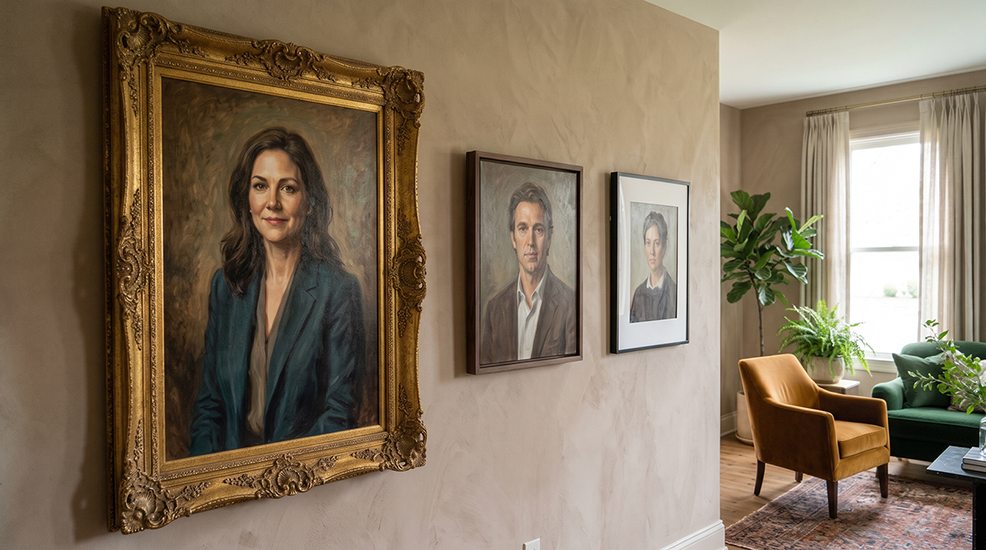
The Frame That Makes the Difference: How to Choose a Frame That Elevates a Commissioned Portrait Painting
A commissioned portrait painting passes through many decisions: the photograph, the technique, the composition, the colors. It is easy to treat the frame as a technical matter that can wait until the painting is finished. Yet the frame is where the painting meets the room. It decides whether the portrait will look like part of the home or like an object that happens to hang on the wall.
The Metropolitan Museum of Art in New York puts this in a single sentence, in an essay on Italian Renaissance frames. According to its authors, pictures have always had to live quietly among furniture from a period other than their own. The frame is what made that possible. That sentence holds most of the answer to the question of how to choose a frame for a portrait painting: the choice does not follow from the painting alone, and it does not follow from the sofa alone. The frame is the link between them.
The Frame Was Born as Part of the Wall
According to the Getty Museum, wooden frames around works of art emerged in Italy in about the thirteenth century. Gene Karraker, formerly the museum's frame conservator, said that the frame's original purpose was simply to protect the painting. Those early paintings, which were usually religious, were built into the architecture of the church. Their frames were mostly modeled on the moldings around its doors and windows.
The Met widens the picture. According to the essay, frames for paintings were designed as part of the architectural space. Many were meant to harmonize with the surrounds of doors and windows. Their color, shape and ornament were shaped by their setting at least as much as by the work inside them.
The turning point came in 1423. Gentile da Fabriano then introduced an independent frame that stood on its own. The museum describes this as a first and decisive step toward the modern idea of the frame: a structure built to hold a work of art rather than an inseparable part of it. Ever since, the frame has lived between two worlds, the painting inside it and the room around it.
The Portrait Got a Frame of Its Own
The portrait, too, found its own form. According to the Met, secular subjects such as portraiture called for frames without any overt religious reference. The cassetta frame, Italian for "small box," became the dominant form across the Italian peninsula. Unlike the tabernacle frame, which borrowed its shape from wall niches and window surrounds, the cassetta keeps an identical profile on all four sides.
The same essay offers a detail that speaks directly to the choice between natural wood and gold. Walnut was rarer and more costly than the other woods used for frames. It served for frames that were left ungilded, and its rich color was highly valued. In other words, a frame without gold could be the more expensive choice.
A New Owner, a New Frame
What came next will sound familiar to anyone who has ever redecorated a home. According to the Met, for most of the modern era a painting lost its original frame whenever it changed hands. A new frame, better suited to its new setting, took its place. Frames were also often replaced when the interior décor was renewed. It took until the end of the nineteenth century for museums and private collectors to start valuing historical authenticity in the frame itself.
The Getty describes the same phenomenon from the owner's side. The style of the frame became the owner's way of leaving a personal mark on the work. An owner could choose a frame to suit the décor of the house. A museum might adopt a single style, as the National Museum of Dresden has done with its paintings since the eighteenth century.
In the seventeenth and eighteenth centuries, Paris enjoyed what the Getty calls a golden age of frame-making. The museum's first exhibition devoted to frames showed frames made under four French monarchs, from Louis XIII to Louis XVI, as French design in "wall furniture." Frames turned into a display of craft, invention, taste and riches. The kings of France led the way in setting their style.
The term "wall furniture" sums up the whole idea. The frame belongs to the furnishings no less than it belongs to the painting. Choosing a frame is therefore an interior design decision.
When the Frame Swallows the Painting: Van Gogh's Irises
Matching the furniture can also go wrong. A telling example reached the Getty along with Vincent van Gogh's Irises. The museum bought the painting from a collector in New York who had hung it in her dining room. The walls of that room were clad in heavy walnut paneling. The frame on the painting matched that décor.
According to Karraker, this was done so that the painting would disappear into its surroundings. Outside that room, in a gallery, it made no sense at all. The frame on Irises today is Italian and dates from the seventeenth century. The curators felt that it complements the work.
That is a sharp lesson for anyone matching a frame to the furniture. A frame that copies the room can make the painting vanish into it. Karraker does say that a frame doing its job properly disappears. But the Getty makes clear what should be seen in its place: the viewer is meant to notice the work, not the frame. The frame steps back for the painting. The painting does not step back for the room.
The White Frame: Painters Take the Decision into Their Own Hands
From the mid-nineteenth century onward, a growing number of painters designed the frames for their own canvases. According to the Getty, Edgar Degas sketched such designs and often chose a white frame. The Impressionists did the same at their first exhibition. In this way they set their avant-garde paintings apart from the largely conservative, gold-framed work shown at the official Salons. Gold returned to favor as the century closed, though with minimal ornament.
Karraker tells what became of that choice. When very wealthy Americans began buying Impressionist works, they wanted their collections to look more important. That, he says, is why the eye has grown used to seeing these paintings in heavily ornamented gilt frames. He adds that this is probably not what the artist intended.
One Portrait, One Frame and an Entire Room
James McNeill Whistler painted Christina Spartali, an Anglo-Greek beauty, wearing a Japanese kimono. La Princesse du pays de la porcelaine (The Princess from the Land of Porcelain) was painted in 1864 as an exhibition picture and shown the following year at the Paris Salon. It was not originally made for any particular place.
Whistler designed and decorated its frame himself. The catalog of his paintings at the University of Glasgow ranks it among the finest and most intricate of his frames. Its frieze carries Japanese mon roundels, its corners stylized chrysanthemums, and its inner edge a Greek key pattern. It is believed never to have left the painting since 1864. The Japanese roundels on the frame and the kimono in the painting speak the same language.
The British shipping magnate Frederick Leyland bought the painting and hung it over the fireplace in his dining room. The architect Thomas Jeckyll had redesigned that room to display Leyland's collection of blue-and-white Chinese porcelain. Whistler proposed changes to the room's colors that, he told Leyland, would harmonize better with the palette of the painting. Out of those modest changes grew an entire room. Whistler covered the walls, the shutters and the ceiling with peacock motifs. Thus was born Harmony in Blue and Gold: The Peacock Room.
In that room the framed painting received a second frame. According to the Glasgow catalog, decorative shelving was designed specifically to surround it. A frame within a frame, both of them built around a single portrait. Charles Lang Freer later bought the entire room. In 1904 he moved it to his home in Detroit and hung the princess over the fireplace once again. She was still there when the room was set up at the Freer Gallery of Art in 1920.
Few people will build a whole room around a portrait. Whistler's lesson still applies to an ordinary home: a frame can draw a color or a pattern out of the painting and carry it into the room.
Three Museum Considerations and What They Say About the Living Room
A Getty article draws on Karraker's book about European frames for three considerations in matching an antique frame to a work of art: the period, the place of origin and the artist. The article also states that a frame is a work of art in its own right, but it must never overshadow or overpower the painting.
The Dutch example shows how these considerations work together. According to the Getty, works by Vermeer and Rembrandt are often framed in simple, elegant wooden frames. The curves of the polished wood caught the candlelight of a seventeenth-century home. The simplicity is deceptive: the wood was costly and hard to obtain, with ebony as the clearest example. French frames of the eighteenth century, by contrast, were heavy with ornament and detail.
A commissioned portrait painting is a work of the present. These considerations can therefore be translated into the language of the home. In that translation, the period is the period of the room where the painting will hang. The place of origin is the style of the house. The artist is what the painting itself asks for: its colors, its lines and its background. Light, as the Dutch home shows, is a fourth consideration no less important than the other three.
Frame, Furniture and Room Colors: Five Questions Before You Decide
This history translates into five questions worth asking before choosing a frame for a portrait painting in a living or working space.
- What material are the doors, windows and door frames made of? Many frames in the past were meant to harmonize with door frames and window surrounds. In a home where natural wood, metal or plain white paint recurs, the question is whether the frame of the painting should continue that material or stand against it.
- Does the frame of the painting copy the furniture or mediate between the furniture and the painting? Irises in a walnut-paneled dining room shows what happens when it copies.
- What does the painting itself say? Whistler's frame repeats the Japanese motifs of the painting. The simpler frames of the Impressionists were meant, in their view, to complement the work better.
- How does the light fall on the wall? Polished wood caught the candlelight in the Dutch home. Facing a large window, some people choose glazing with an anti-reflective coating. According to the Canadian Conservation Institute, such glazing is almost invisible from a normal viewing distance.
- Is the room likely to change? For most of the modern era, frames were replaced when the interior décor was renewed. The frame is the part that can be updated along with the home. The painting stays with you forever.
These questions continue a process of matching that begins before the frame. You can commission a painting whose size, color or subject is adapted to the room. For more on the wider connection between a portrait and a living or working space, see the article on portrait painting in interior design.
What the Frame Protects
The Canadian Conservation Institute points out that framing matters both aesthetically and as a measure of preventive conservation. The frame protects and supports the work during handling, storage and display. It has to be strong enough to carry the weight of the painting safely. Above all, the painted surface must be kept out of direct contact with the rabbet, the inner recess of the frame. Nails have no place in framing a painting.
A frame can also hold glazing, either glass or acrylic. According to the institute, glazing adds protection against accidental damage and a degree of airtightness that reduces dirt, dust and air pollutants. It is sometimes warranted for paintings whose surfaces are especially fragile. Where glazing is used, it must stay clear of the paint, held away from it by a spacer.
The institute adds that sometimes the artist chose or made the original frame. In that case the frame is an integral part of the work. Many frames also carry valuable information on labels, inscriptions and stamps. One example is the inscription carved on the frame of one of Jan van Eyck's portraits.
With drawings and watercolors the situation is different: a drawing on paper is meant to hang in a frame with glass. A watercolor portrait is meant to be kept behind glass. Mats and the choice of glazing material are covered in detail in the article on the three drawing media.
Framing as Part of the Commission
An oil portrait is painted on canvas stretched on a firm wooden frame. That is the frame behind the canvas. It is not the decorative frame that surrounds the painting on the wall.
Anyone who wants to frame the portrait painting and prepare it for hanging can turn to any framing service near where they live. Remember to go to the framer only once the painting is completely dry. This note follows the conservation rule set out by the Canadian institute: paint and varnish must be dry before a painting goes into its frame. It is advisable to start with mockups of different frames in order to test framing options on the wall itself. Anyone who is unsure can consult the painter even before deciding on a commissioned portrait painting.
Frequently Asked Questions About a Frame for a Portrait Painting
How do you choose a frame for a portrait painting? The Getty Museum lists three considerations for matching a frame: the period, the place of origin and the artist. At home these considerations translate into questions about the painting, the room and the light that falls on them.
Should the frame match the furniture or the painting? Both, but not to the same degree. The Met describes frames meant to harmonize with doors and windows. The Getty describes a frame that copied the wood paneling of a dining room until the painting vanished into it. The frame mediates between the painting and the room. It must not overshadow the painting.
Does an oil painting need glass? Not necessarily. According to the Canadian Conservation Institute, a frame can hold glazing, which adds protection and is sometimes warranted for paintings with especially fragile surfaces. If it is used, it must not touch the paint surface.
What frame suits a drawing or a watercolor? A drawing on paper is meant to hang in a frame with glass. A watercolor portrait, too, is meant to be kept behind glass. Both techniques are described in more detail on the pages for portrait drawings and watercolor portraits.
When should an oil painting be framed? Once the paint and the varnish have dried. That is the guidance of the Canadian Conservation Institute. Remember to bring the painting to the framer only when it is completely dry.
Can the frame be replaced in the future? Yes. For most of the modern era, frames were replaced when a painting passed to new owners and when the interior décor was renewed. A frame chosen by the artist is a different case, because it is part of the work.
Can a commissioned portrait painting be delivered already framed? No. A framing service for portrait paintings operated for a long time, but it has been discontinued, and framing is now entirely the client's responsibility.
The Wall, the Painting and the Frame
A commissioned portrait painting begins with the face of a particular person. The frame is what brings that face into the home, into the furniture, the colors and the light. A well-chosen frame for a portrait painting does not draw the eye to itself. It lets the painting look as though it were born together with the wall.
You can see the range of techniques and styles in the portrait painting galleries. From there it is a short way to the first decision, the one that comes before the frame.
Commission a portrait painting that suits your living or working space