


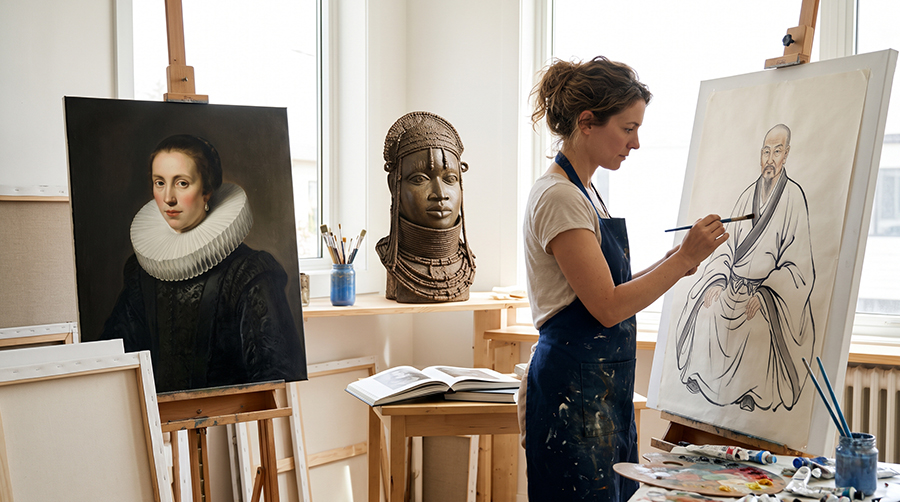
I paint commissioned portraits. The same question returns before every one, and it is far older than I am: what makes a painted image this particular person and nobody else. The obvious answer is the face. Looking at how other traditions answered it, I found the face is one answer among several — and a younger one than I had assumed, in Europe too.
This article sets three portrait traditions beside one another: the painted portrait in Europe, the carved figure in West and Central Africa, and the ancestor and Zen portraits of East Asia. Every claim rests on a record from a museum I name, with a link to the work itself. The European history is written up separately on my page about famous portrait paintings around the world, so the European section here is short.
What exactly is being asked of a portrait
A portrait sets out to tie an image to a person. That tie can be fastened in more than one place: in the face, the clothing, the office, an emblem, an inscription, or the place where the image stands. The difference between these traditions is not whether they wanted to identify a person. All of them did. The difference is where they lodged the identification.
Europe: the face against the signature on the frame
The Metropolitan Museum of Art defines the hallmark of European portraiture as a sense of reality, an apparent intention to depict the unique appearance of a particular person. Two careful hedges sit in that wording — "a sense of" and "an apparent intention" — and I carry them across deliberately. They do not promise that the painting records how the sitter looked.
The Met adds something that surprised me. After many centuries in which generic representation had been the norm, distinctive portrait likenesses began to reappear in Europe in the fifteenth century. Not appear. Reappear. Europe painted whole generations without individual likeness and came back to it, and that return is what we call a portrait today. The three-quarter face, which allows greater engagement between sitter and viewer, was widely favoured then.
Jan van Eyck's "Portrait of a Man (Self Portrait?)", in the National Gallery in London, holds the whole logic in a single object. An inscription in abbreviated Latin is cut into the frame: Jan van Eyck made me on 21 October 1433. The sitter's name is absent, as was usual for his portraits. In its place stands the painter's motto, Als Ich Can, in large Greek letters. Notice what was recorded and what was left out: the painter is signed, the date is fixed, the man is anonymous. The Gallery writes that he is almost certainly van Eyck himself; no other portraits of him survive to confirm it. Even here, where we expect certainty, there is none.
When the name does matter, it enters by another route. The Ambassadors, painted by Hans Holbein the Younger in 1533, was commissioned by Jean de Dinteville himself. The portrait of Oopjen Coppit was commissioned from Amsterdam's leading portraitist, Rembrandt van Rijn, to mark her marriage. The identification sits in documents, in the commission, in family history; the painting carries the face. The last section of this article rests on that division.
West and Central Africa: three answers, not one
A caution is needed here, and not a technical one. A continent is not a tradition. The three cases below give three different answers, so I take each separately.
Ile-Ife in Nigeria: a detailed face, an unknown identity
Between roughly the thirteenth and the fifteenth century Ile-Ife grew into a flourishing artistic centre. The brass head in the British Museum was cast by the lost-wax method, stands a little under life size and is naturalistic in style, with vertical lines incised into the face. The museum dates it to the fourteenth or early fifteenth century, with the word "probably" attached. It was found by accident in 1938 at Wunmonije Compound during building work, with sixteen other brass and copper heads.
Who is shown in it? The museum writes that the identification and the function remain uncertain. The elaborate beaded headdress, possibly a crown, suggests a connection to an Ooni, a ruler of Ife. The Met describes the style alternately as naturalistic, portraitlike and humanistic, and in the same breath calls the crowned royal figures among these works idealized. The vertical lines appear on many of the sculptures and may represent scarification patterns. The naturalistic style was developed first in terracotta and only later in metal.
The Kingdom of Benin in Nigeria: commemoration marks an office
The first obligation of each new king in the Kingdom of Benin, at the transfer of rule, is to commemorate his father with a cast portrait placed on an altar in the palace. The commemorative head in the Cleveland Museum of Art is dated to the mid-sixteenth or early seventeenth century, with the word "possibly" attached, and is attributed to the royal brasscasters' guild. The museum writes a sentence that holds two things at once: the head represents an individual, while his facial features and calm expression are idealized.
The Met puts it more strongly. This genre, the museum writes, is highly stylized and does not portray recognizable facial features; what it shows is the dead king at the prime of his life. So how is it known who is shown? By the crown. The heads of queen mothers are distinguished from those of kings by the forward-pointing peaks of their coral-beaded crowns. Of the palace plaques the Met writes that their makers were far more concerned with communicating hierarchy and status than with capturing individual physical features.
One generalisation is blocked here at once: brass heads of the first half of the sixteenth century are distinguished precisely by their naturalism. Even where the crown carries the identification, the face is not neglected.
The Kuba in the Congo: the emblem in front of the figure
The sharpest case comes from the ndop figures. Around 1700 King Mishe miShyaang aMbul introduced a genre of wooden portrait sculpture. In these figures the identity of each ruler is communicated by an attribute shown in front of him — his ibol, a personal symbol revealed at his coronation. The ibol of Shyaam aMbul aNgoong is a lele board, a game of strategy. On his installation the new nyim announced a praise name, a geometric pattern and a signature emblem, and those three became the identifying symbols of his reign.
The Met calls the result a paradox, in that word: the genre was designed to make the essence of an individual manifest while deliberately obscuring differences in facial features, through adherence to an established visual vocabulary. The obscuring is a choice, not a limit of the carver. The museum explains why in the same place: images of rulers carved within one stylistic tradition tended to look very much alike, so personal emblems unique to each individual were used instead.
The ndop in the Brooklyn Museum is dated to roughly 1760 to 1780, made of wood, pigment and fibre, and stands about fifty centimetres high. The museum links it to three different nyim, and reads that as evidence of how highly the Kuba valued uniformity in these figures. Even the emblem, then, does not settle the identification in every case.
One thing the museums do not agree on, and I am writing it out plainly. The Royal Museum for Central Africa writes that the figures were made after the death of the ruler they represent. The Met writes that the figure served the ruler in his lifetime as his spirit double. The two are not saying the same thing, and I am in no position to decide between them.
East Asia: the object that stays after the person
The Chinese ancestor portrait
In the Israel Museum in Jerusalem hangs a Chinese ancestor portrait from the end of the nineteenth century, from the Qing dynasty. It shows an official of the Lin family and his wife, in colours on paper, and it measures 222 by 78 centimetres.
The Smithsonian describes the genre this way. An ancestor portrait is mounted as a hanging scroll and shows the whole body. The face is painted as accurately as possible, and beside it, of almost equal importance, the clothing is described in detail, because it signifies the sitter's social standing and brings glory to the family. The strictly frontal pose, the covered hands and the almost life-size scale are typical. Square badges on the chest of the court robe indicate the sitter's rank as an official, and wives wore the same badge. Scrolls of this kind hung above the household altar for worship at the New Year celebrations.
Here comes the detail that turned the picture around for me. A sense of realism is crucial in painting the face, while the painters avoid giving the setting a realistic appearance, because the ancestor is not supposed to be present in the physical world. The background is not absent. It is present, and unrealistic on purpose.
How far this goes can be seen in three portraits in the Smithsonian collection. All three were made at about the same time, using the same stencil for the outlines of the chairs and of the sitters' bodies. The faces, by contrast, are rendered in radically different styles. The same exhibition showed a painter's sketchbook of classic faces, from which descendants could select suitable features to reconstruct a dead relative's likeness from memory. Some portraits were painted after an artist was invited to see the corpse.
These portraits were not regarded as art but as ritual objects, and the painters were expected to efface themselves entirely from the image. Faces are almost always rendered in exceptional detail. Once a forebear had been dead for more than three generations and was deemed a distant ancestor, painstaking fidelity was no longer required. Anyone who knows the portraits of rabbis and tzaddikim on this site will find a familiar echo: a painting meant to connect the viewer to someone no longer there.
The Japanese chinsō: a portrait that is a certificate
In Japan the tie between image and person took an almost legal form. The Kyoto National Museum writes that Zen portraits served many purposes, while their primary function was to certify the transmission of religious lineages. A master's agreement to write an inscription on a portrait brought to him by his disciple meant that the master was formally choosing that disciple as his successor. Such portraits are called chinsō in Japanese, which means, literally, countenance of the peak.
The chinsō is a genre of naturalistic portraiture reserved for high-ranking Zen monks and abbots, typically shown seated in a carved lacquer chair and wearing official robes, with the details of their facial features carefully reproduced. Teaching from heart to heart, without the aid of sutras, is a central idea in Zen, and it is what made these portraits more important within Zen than icons of Buddhist deities.
Even so, the Met qualifies it: premodern Japanese portraiture does not necessarily present an accurate likeness of the sitter. In the Kamakura period the yamato-e painters took up portraiture, and the realistic depictions became known as nise-e, paintings meant to resemble the person themselves. They were intended as faithful representations of particular personalities, as against the highly stylized faces of the narrative handscrolls.
What China itself said about likeness
The Wilfrid Israel Museum writes that in the first centuries of the common era the portrait was the central subject in Chinese painting, and that from the eleventh century its place was pushed aside in favour of landscape. The aim of the traditional Chinese painter, according to the Met, is to capture not only a subject's outward appearance but its inner essence as well — its life force and its spirit. Conveying that inner spirit, chuanshen, is the central aspect of figural representation in Chinese art. Towards the end of the fifth century the critic Xie He proposed six criteria for judging painting, and the first of them, spiritual resonance and lifelike motion, later became the most fundamental quality in the great Chinese works of the brush.
The sentence that brought down my whole assumption sits on a single label in the Met's collection. The museum writes that the traditional criterion for lifelikeness in Chinese painting was brush vitality rather than optical fidelity — except in portraiture — and that for exactly that reason portrait painting was traditionally held in low regard in China. The scholar-artists left formal portraiture to professional artisans, who in their eyes might be skilled at capturing a likeness without ever hoping to convey the deeper aspects of character.
Put differently: the familiar formula, that the East sought spirit in place of appearance, turns over when you reach the portrait. There, appearance was precisely what was demanded, and that demand is what lowered its standing.
Fayum: the case that breaks the division
One case breaks all three boxes at once. The portraits of the dead from Roman Egypt were painted on wooden panels and on linen shrouds and incorporated into the wrappings of the mummy. They join the technical methods and style of Graeco-Roman culture to the rituals of an Egyptian funerary tradition that began more than two and a half thousand years earlier. This panel art flourished from the first century of the common era to the third. Most were painted in encaustic, in which pigments were mixed with hot or cold beeswax, along with egg, resin and linseed oil. One such mummy, with its portrait, is held in the Met.
The Getty writes that many of these portraits are remarkably realistic depictions of individuals. The Art Institute of Chicago adds that the identities of most sitters are not known. Notice the parallel: a detailed face and an unknown identity — exactly as at Ile-Ife, a continent and a millennium away.
The name "Fayum portraits" is itself inexact, because later discoveries showed that painted funerary portraits were used across a wide area, from the Mediterranean coast as far as Aswan. The geography cuts across the line we draw between Africa and the Mediterranean. The categories in this article's title are a working convenience. They are not walls.
Two claims that two museums make about us
The two stereotypes heard on this subject are not my invention. They can be read in the words of the institutions themselves.
The British Museum records that when objects from Ife were first presented to the western world they were compared with the classical traditions of ancient Greece and Rome, and that it was even suggested such heads were evidence that Ife had been the site of the lost civilization of Atlantis. Europe met naturalistic African sculpture and preferred inventing a lost continent to correcting its assumption. The Met writes that the discovery of these works challenged European assumptions about the nature of African art and opened a serious debate about the antiquity of its past.
In 2006 the Smithsonian opened an exhibition called Facing East: Portraits from Asia. Its page states that popular and academic surveys of portraiture deny that Asia had a portrait tradition. The exhibition was mounted to dispute that.
These two denials are the same denial. It assumes the portrait is a European invention and that everywhere else did something else. The museums that hold the objects say otherwise.
The three portrait traditions side by side
Europe · identification lodged in: the face and the commission documents.
Carried by: individual likeness, three-quarter view, the painter's signature.
Where it stood: the house, the guild hall, the church.
The Kingdom of Benin in Nigeria · identification lodged in: the crown and the regalia of rank.
Carried by: an idealized king at the prime of his life.
Where it stood: the ancestral altar in the palace.
The Kuba in the Congo · identification lodged in: the personal emblem in front of the figure.
Carried by: deliberate blurring of facial features.
Where it stood: at the rites of burial and succession, and afterwards as a memorial.
The Chinese ancestor portrait · identification lodged in: the face, and the rank of the robe.
Carried by: a realistic face in a deliberately unrealistic setting.
Where it hung: above the household altar, at the New Year.
The Japanese chinsō · identification lodged in: the inscription written by the master.
Carried by: certification of a teaching lineage.
Where it stood: the monastery, in the hands of the disciple who received it.
Want to see commissioned portrait paintings? Visit the galleries
From here to a commissioned portrait
What has any of this to do with someone who wants a painting of a person they love today? A great deal, because every decision above is still open in your commission, even if nobody names it.
The first decision is how much of the person sits in the face and how much in everything else. The Chinese ancestor portrait paints the face as accurately as it can and gives nearly the same attention to the robe. The ndop puts the whole weight on a single emblem. The photograph you send me raises the same question: what goes in besides the face? A particular shirt, an instrument, a uniform, a book, an animal. These are not decoration. They are our equivalent of the ibol.
The second decision is what to do with the background. The Smithsonian explains that the Chinese painters avoided a realistic setting on purpose. Your commission offers three possibilities too: keep the background in the photograph, replace it, or drop it. There is no single right answer. There is a choice, and it changes the painting.
The third decision is when the painting is made. The Ambassadors was painted in front of living men. The ndop of Shyaam aMbul aNgoong was carved a century after his reign. An ancestor portrait was sometimes painted in a person's lifetime, sometimes after their death. I work from a photograph, and quite often the painting is made in order to remember. That work has a few thousand years behind it.
The Met writes a sentence that carries almost unchanged into the present: a portrait was often commissioned at a significant moment in someone's life, such as a betrothal, a marriage or an elevation to an office, and making one generally involved a simple arrangement between artist and patron. Little has changed. A birthday, a wedding, an anniversary, a retirement, a birth, a remembrance. A couple portrait or a family portrait puts the question twice over.
The material is part of the answer too, not a wrapper around it. The National Gallery writes that oil paint dries slowly, is more flexible than egg tempera and allowed a wide range of optical effects. In oil on canvas I build in layers, for that reason. In watercolour the work is transparent and nearly irreversible. In pencil, ink or charcoal it narrows to line and shadow, and those three have a post of their own. In relief the shadow comes from depth and is not painted in, which has its own post. In a digital portrait the work is done by hand on a drawing tablet.
The three portrait traditions here agree on one thing, even where they agree on nothing else. All of them made an image meant to outlast the changes in the person. That is also why people commission a painting instead of settling for a photograph. A photograph catches one moment; a painting demands hours, and in those hours what the moment did not show gets in as well. I have written separately on how to get a vivid portrait, and on the painters working on the same question today in contemporary portrait painters.
To commission a portrait
Have a photograph of someone you would like painted? Talk to me. With the photograph I ask for a few details about the person and the occasion, because they go into the painting. We will choose the technique and the size together. The techniques are in the portrait galleries, the terms on the prices page.