


Between Transparency and Depth: The Hidden Advantages of Choosing Watercolor for a Custom Portrait Painting
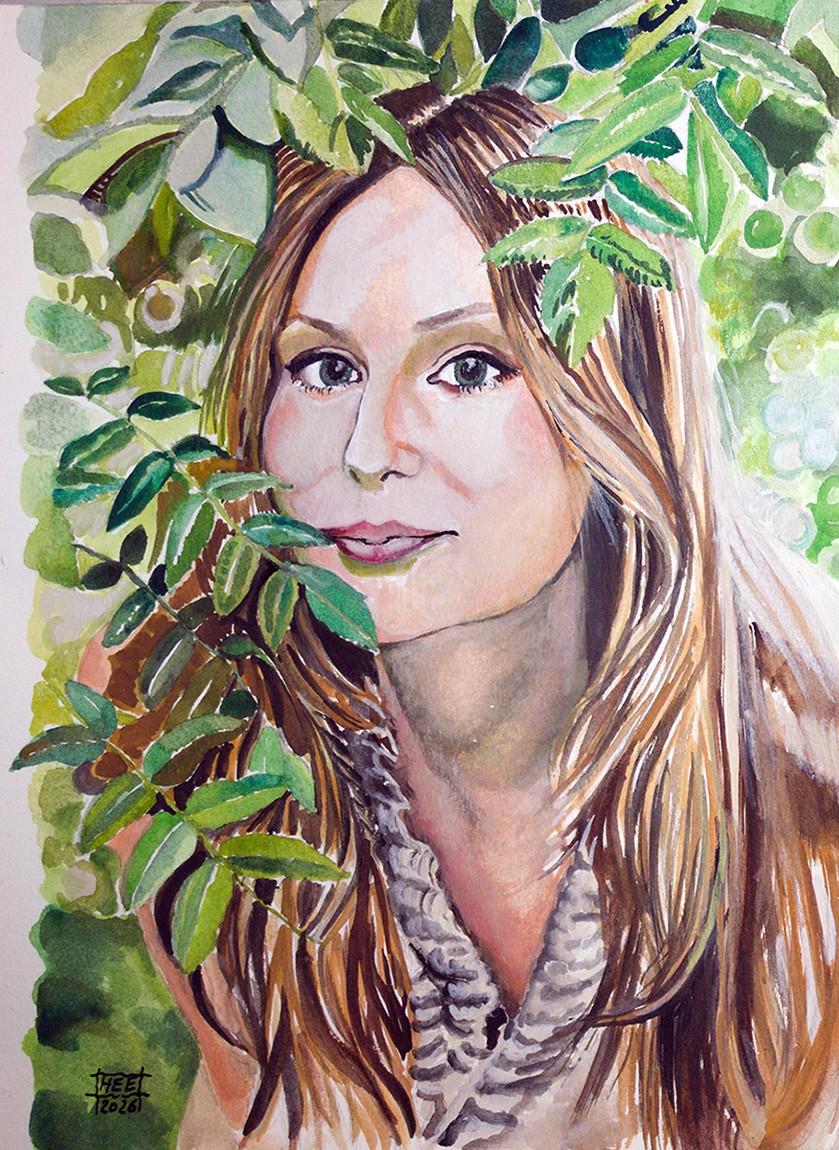
In sixteenth-century English, painting in watercolor was called limning. As London's Victoria and Albert Museum explains, the word comes from the Latin luminare, "to give light." The old term suits today's watercolors remarkably well. In a watercolor portrait painting, the light comes from the white paper, which glows through the transparent layers of paint.
The museum observes that watercolor is thought of nowadays as thin and transparent. Does that mean it is pale and flat? This article follows watercolor from the lockets of the English royal court to the research laboratory. It sets out to show that transparency is, in fact, the source of its depth. In the process, it takes up several questions: where the light in watercolor comes from and how depth is built in it, why watercolor in particular became bound up with intimate gifts, how a custom watercolor portrait painting is made, and how to preserve it for years.
Where Does the Light in a Watercolor Painting Come From?
According to Tate's glossary of art terms, watercolor is a paint that dissolves in water and is transparent by nature. It consists of fine particles of pigment held in a binder that is itself water-soluble. It is usually applied to paper. The Victoria and Albert Museum adds that the binder is typically gum arabic. Once the water has evaporated, the binder is what holds the pigment to the surface.
Watercolor is semi-transparent. That is why the whiteness of the paper lends the thin layers of color a natural glow. White areas in a painting are often simply left unpainted, so that the paper itself shows through. Turner and many of his contemporaries made use of the radiance of white paper: rather than adding white paint for the highlights, as oil painters could, they scraped dry paint off the sheet and uncovered the white beneath. In oil, light can be added with paint. In watercolor, it can also be revealed from the paper.
Watercolor has also lent its name to a phenomenon in vision science. In 2001, three researchers described in the journal Vision Research an illusion they called the "Watercolor Effect." According to the study, a colored line running alongside a darker border makes its color seem to spread into the white area it encloses. Against a white background the spreading is stronger than against a colored, gray or black one. To the viewer's eye, white is not empty.
Are Watercolors Pale and Flat?
Not necessarily. The Victoria and Albert Museum cites the self-portrait Simon Bening painted in 1558 as evidence that the watercolor painting of that period was rich and opaque. Perhaps surprisingly, watercolor "can be thick and softly opaque." Mixed with a good deal of gum, it turns glossy.
As early as the mid-nineteenth century, when the museum's watercolor collection was being formed, its curators dismissed early works from the eighteenth century as pale "drawings" rather than paintings. In their eyes, paleness was the mark of an early stage. In those years, watercolor was regarded as a national art form in Britain and was proudly shown at major international exhibitions.
Depth is built in layers. In 1997, at the SIGGRAPH conference, Cassidy Curtis and colleagues presented a study that simulated the behavior of watercolor on a computer. The researchers came from the University of Washington, Stanford University and Pixar Animation Studios. In their words, "Watercolor is like no other medium": its intense hues and spontaneous forms lend it a charm all its own. In delicate layers, even the most ordinary subject can be given a transparent, glowing quality.
One of the most important methods for this is to lay very thin, very pale washes of paint one over another until a clear, even effect emerges. According to the researchers, the pigments in such layers are mixed not physically but optically, as they build up on the paper. The result is often described as "luminous" or as "glowing from within." Each layer on its own is pale. The depth comes from their accumulation.
The dark line at the edge of a patch of color is born of the water, too. When a brushstroke on dry paper starts to dry, the pigment travels from the inside of the painted area toward its rim and leaves a dark deposit there. Watercolor painters rely on this effect. According to the researchers, the same thing happens whenever a suspension evaporates while the drop's contact line stays pinned in place. Here they cite the work of a group at the University of Chicago. In a 1997 paper in the journal Nature, the group explained the same phenomenon in a drop of coffee: as it dries on a solid surface, the drop leaves a dense, ring-shaped deposit along its edge. Curtis and colleagues suspect that the impression of an inner glow arises, of all things, from this darkening at the edges.
A Portrait Held in the Hand: Watercolor and Intimacy
The Victoria and Albert Museum dates the earliest portrait miniatures to the 1520s. They were painted for two royal courts: that of Henry VIII in England and that of Francis I in France. The medium was watercolor on vellum, a fine animal skin. The portraits were kept in lockets or in lidded boxes, so they could be worn or carried in a pocket. The museum notes that in skilled hands these small portraits have "an intimacy and power quite unlike a larger oil portrait."
Hans Holbein the Younger painted Anne, the woman Henry VIII planned to marry, both in oil and as a miniature, so that the king could judge her face and figure. According to the museum, the oil portrait, which is now in the Louvre, directs attention to her costume and jewels. The miniature can be held in the hand and examined up close. It draws the eye to her face. Watercolor on vellum, the museum adds, has a soft, matte quality that seems especially suited to depicting a face.
Another Holbein miniature, from around 1540, almost certainly shows Jane, the wife of a London merchant named Nicholas Small. It was probably commissioned to celebrate their marriage. In the museum's words, Holbein painted "a portrait of great beauty and intimacy for Nicholas to hold and contemplate." Even then, a watercolor portrait served as a keepsake of love.
In the late 1570s, Nicholas Hilliard was appointed official limner, or miniature painter, to Queen Elizabeth I. According to the museum, his small, portable portraits frequently passed between lovers or were given as cherished gifts. That made them intimate objects of great emotional value. "Young Man Among Roses," watercolor on vellum from around 1587, is perhaps the most celebrated of English portrait miniatures. It most likely depicts a young courtier. The roses surrounding him may stand for love or for the Tudor dynasty.
The Metropolitan Museum of Art describes these miniatures as delicate pieces set in gold lockets, brooches and bracelets. In this way they drew close to the tradition of jewelry and became keepsakes of refined and intimate meaning. Those who commissioned miniatures were not only members of the royal court. The political elite and the merchant elite alike wished to own and wear small, dazzling portraits of their loved ones. The Victoria and Albert Museum notes that ivory began to replace vellum from around 1700. The Venetian painter Rosalba Carriera was probably the first artist to use watercolor on ivory for portrait miniatures. According to the Met, the glow of ivory enhances skin tones.
Photography pushed the miniatures aside. In the introduction to an 1865 exhibition catalog, the director of the museum in London warned that the art of the miniature had "suddenly collapsed before the cheap mechanical processes of photography." Photography had come into use only twenty-five years before. In effect, it made miniature painters redundant. Today the tables have turned: the photograph is the starting point of a custom watercolor portrait painting.
How Is a Custom Watercolor Portrait Painting Made?
The watercolor portraits of You Are Art are painted by Hee-Lee Soffer on thick, high-quality paper made especially for watercolor. All it takes to begin is a photograph, new or old. You can ask to combine several photos in one painting, choose a particular background, and change the position of a limb, such as a hand.
The work begins with a pencil outline, a delicate and thorough preliminary drawing that follows every detail of the face. Throughout, the painter keeps looking at the photograph. Then come the colors, in transparent, delicate layers. Each layer dries before the next. In this way the details grow sharper and sharper until the portrait emerges: a one-of-a-kind work.
Such care is no luxury. In watercolor, corrections are very difficult. Oil paintings, by contrast, are flexible and can be corrected again and again. The challenging meeting of water and paper is the subject of the article Wind & Matter - Watercolor Portrait. While the work is in progress, the client may request photos showing how it is coming along. Once the painting is complete, a photo of it is sent to the client, who can then request adjustments or corrections.
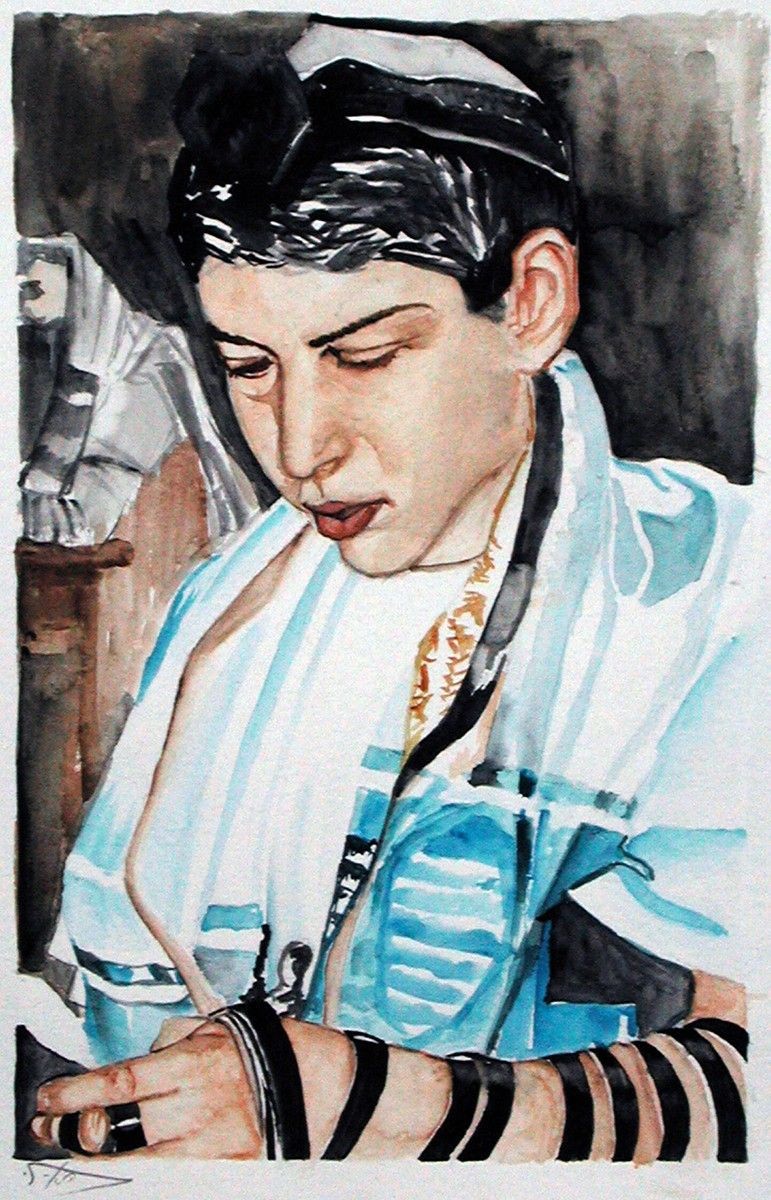
A watercolor portrait painting can be ordered as a gift for a birthday, a wedding, an anniversary, parents, grandparents, a Bar or Bat Mitzvah, or the birth of a son or daughter. It can also be ordered as a retirement gift or as a memorial painting. The portrait can show one person or several figures. A beloved cat or dog can join in, too. For a Bar or Bat Mitzvah, you can order an album of watercolor portraits that follows the child's life from infancy up to that day. The album, bound by hand, is a luxurious symbol of the passage from childhood to adulthood. Pages are left between the paintings for the blessings of family and friends. This is covered further in Portrait Painting - A Classic Gift.
View the gallery of watercolor portrait paintings
Watercolor in Interior Design: A Presence That Does Not Weigh Down
Choosing a technique is also an interior design decision. The technique determines how a work behaves under the room's light and how much of the wall it claims. With aquarelle on paper, the outcome is bright and airy, which is why it blends into a space with delicate tones. Some choose watercolor for exactly this reason: for a space that needs an artistic touch without weighing on the eye. The way paintings are hung has changed, too. At the exhibitions of the watercolor societies in nineteenth-century London, the paintings were crowded side by side, in gilt frames, up the walls. The South Kensington Museum showed them the same way until the close of the century.
Watercolor portraits belong behind glass. The framing itself is the client's responsibility, and any framing service can help. Choosing the frame is the subject of the article Frame for a Portrait Painting.
Where it hangs matters as well: an interior wall, away from direct sunlight. How a portrait painting relates to the space around it is explored in the article Portrait Painting in Interior Design.
How Do You Preserve a Watercolor Portrait Painting for Years?
The Canadian Conservation Institute warns that exposure to light, natural and artificial alike, makes colors fade. Works on paper, such as watercolor paintings, are prone to fading. Damage done by light is irreversible. That is why they are not hung where sunlight can reach them. In the room where the painting hangs, it helps to use curtains or blinds. The institute suggests considering framing behind glass that filters out ultraviolet light.
The Library of Congress adds a caveat. Blocking ultraviolet rays removes the most harmful part of sunlight, but "all light is damaging to paper, not just ultraviolet light." An archival, acid-free mat keeps a gap between the picture and the glazing, so the painting does not touch it. According to the Canadian institute, poor-quality framing materials can pass acids into the paper and cause it to discolor and break down.
The Canadian institute also lists heat and humidity among the dangers. Paper takes up moisture quickly. In very damp air it swells and looks wavy. Heat speeds up the chemical reactions that break it down. That is why an interior wall suits the portrait. According to the Library of Congress, interior walls do not reach the temperature extremes of exterior walls, nor do they carry as much moisture. The Canadian institute advises keeping the painting away from radiators, heating ducts and spotlights. It also warns against displaying or storing it in a basement or an attic.
The question of light already occupied Britain in the nineteenth century. In 1864, curtains were hung above the watercolors at the South Kensington Museum, known today as the Victoria and Albert Museum. They were meant to shield the paintings from fading in daylight while the museum was shut to visitors. In 1886, a British government committee asked Dr. Russell and Captain Abney to conduct a thorough program of experiments on how light affects watercolor paintings. In their report, published in 1888, the two found that 12 of 39 single colors were not affected by light at all. According to their conclusions, mineral colors are much more stable than those made from plants. Among the colors that withstood especially severe exposure to light, a good range remains available to the watercolor painter. In most cases, moisture and oxygen were needed for a color to change.
In his will, Henry Vaughan left thirty-one Turner watercolors to the National Gallery of Ireland. His condition was that they be "exhibited to the public all at one time free of charge during the month of January in every year." The gallery notes that Vaughan took care to follow best practice in how his fragile collection was shown and looked after. The paintings went on view for the first time in January 1901. Because they have not been overexposed to light, they remain in pristine condition some hundred and twenty years later, with vivid, glowing colors.
According to the Canadian institute, "cleaning and repairs are best left to a paper conservator."
Frequently Asked Questions About Watercolor Portrait Painting
Does a watercolor painting fade? Watercolor paintings are prone to fading in light. Damage done by light is irreversible. That is why the portrait is hung away from direct sunlight and framed behind glazing that filters out ultraviolet light. The Turner watercolors at the National Gallery of Ireland, shown only in January, remain in pristine condition some hundred and twenty years after they arrived there.
Should a watercolor painting be hung behind glass? Absolutely. Watercolor portraits belong behind glass. An archival mat keeps a gap between the paper and the glazing, so the painting does not touch it. Glazing that filters out ultraviolet light adds protection. The framing is the client's responsibility.
Are watercolors pale and flat? Not necessarily. The Victoria and Albert Museum shows that watercolor can be rich, opaque and even glossy. Transparent colors build depth as well. When thin layers are laid one over another, the pigments mix optically on the paper. The result is often described as glowing from within.
What is the difference between a watercolor portrait and an oil portrait? In watercolor, the light comes from the white paper, which glows through the transparent layers. In oil, highlights can be added in white paint. An oil painting is flexible when it comes to corrections. In aquarelle, corrections are very difficult. As the Victoria and Albert Museum observes, a small watercolor portrait has an intimacy and power quite different from those of a larger portrait in oils.
Can a watercolor portrait be corrected? Corrections are very difficult in watercolor. That is why the work begins with a thorough preliminary drawing. Once the work is complete, a photo of the painting is sent to the client, who can then request adjustments or corrections.
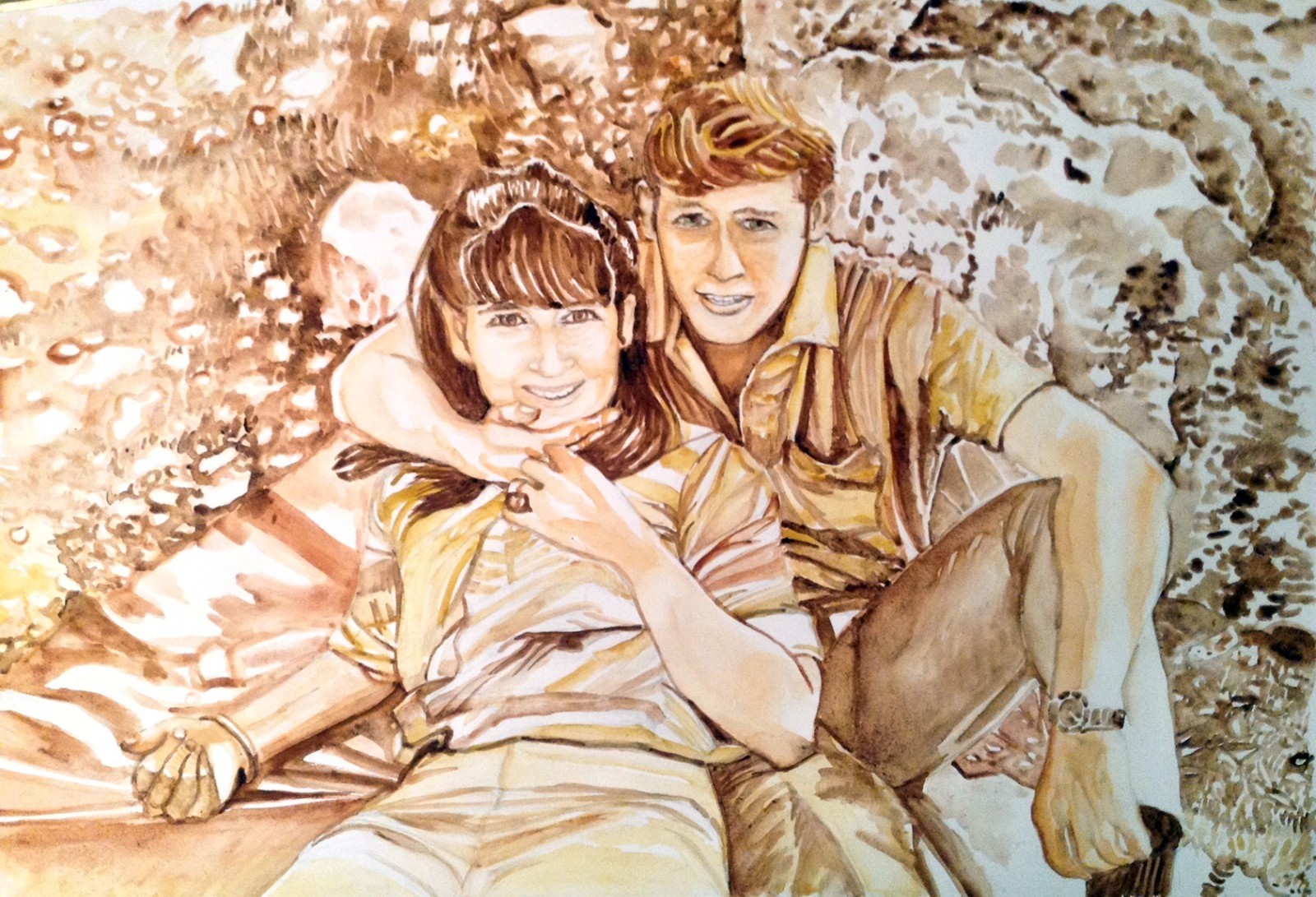
Can a watercolor portrait be ordered from an old photo? Absolutely. All it takes is a photograph, new or old. The gallery in this article includes a portrait of a couple painted from an old photo for their golden wedding anniversary. More details can be found in the article Portrait Painting From Photographs.
How do you care for a watercolor portrait painting? Hang it on an interior wall, away from direct sunlight, radiators and spotlights. Frame it behind glazing that filters out ultraviolet light, with an archival mat that keeps the paper away from the glazing. Avoid basements and attics. For further answers, see Portrait Paintings - Questions and Answers.

Transparency That Holds Depth
The old name for painting in watercolor comes from the Latin word meaning "to give light." It suits what sets a watercolor portrait painting apart: the light rises from the paper, through transparent layers that build the depth. Alongside light and depth, watercolor carries a long tradition of intimate gifts, from the lockets that passed between lovers at Elizabeth's court to the album of portraits for a Bar or Bat Mitzvah. Some choose watercolor precisely for this softness and intimacy.
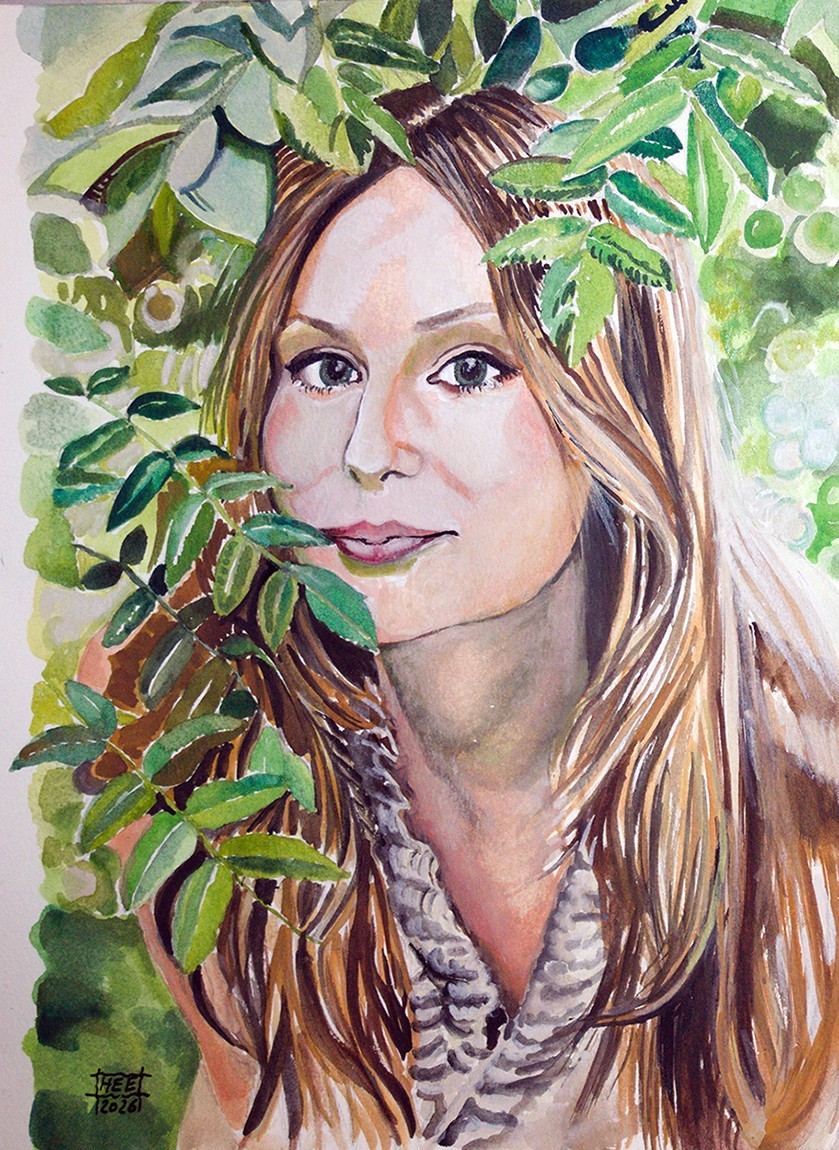
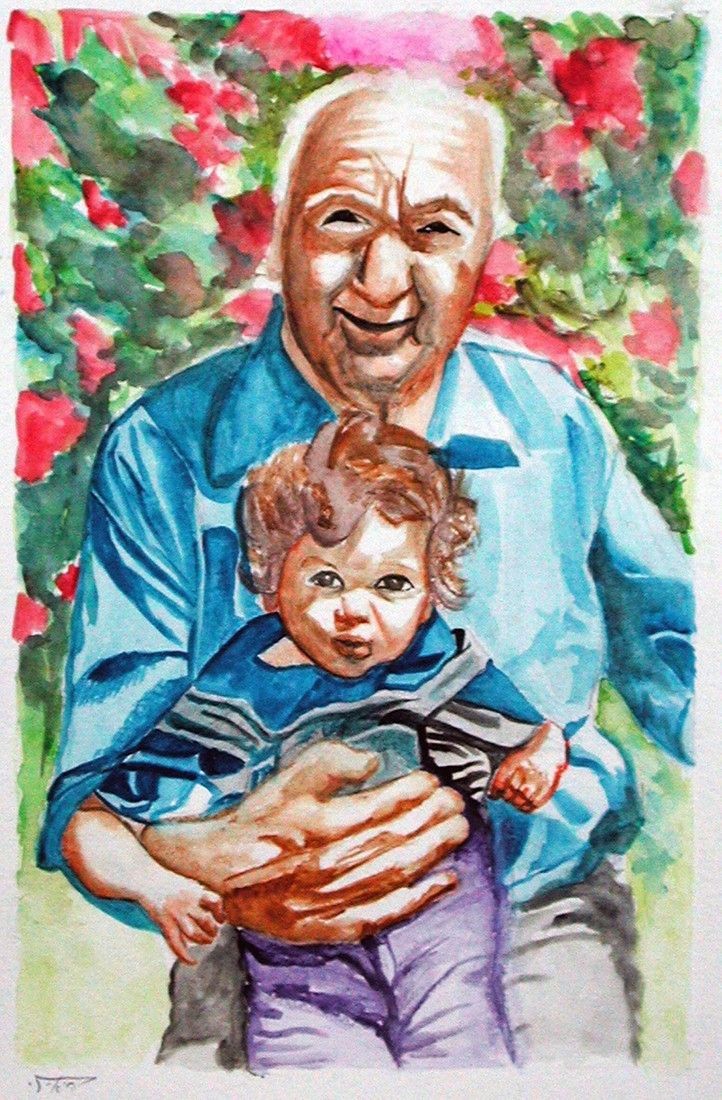
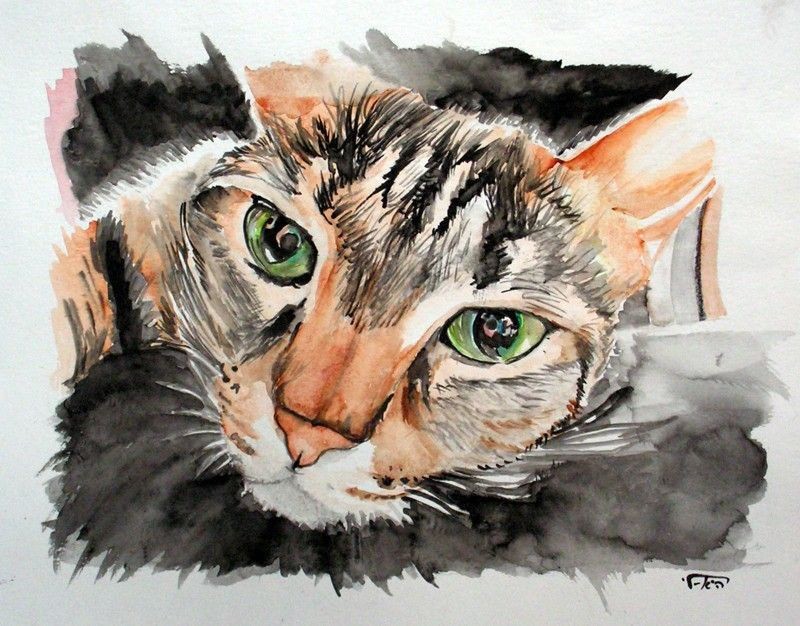
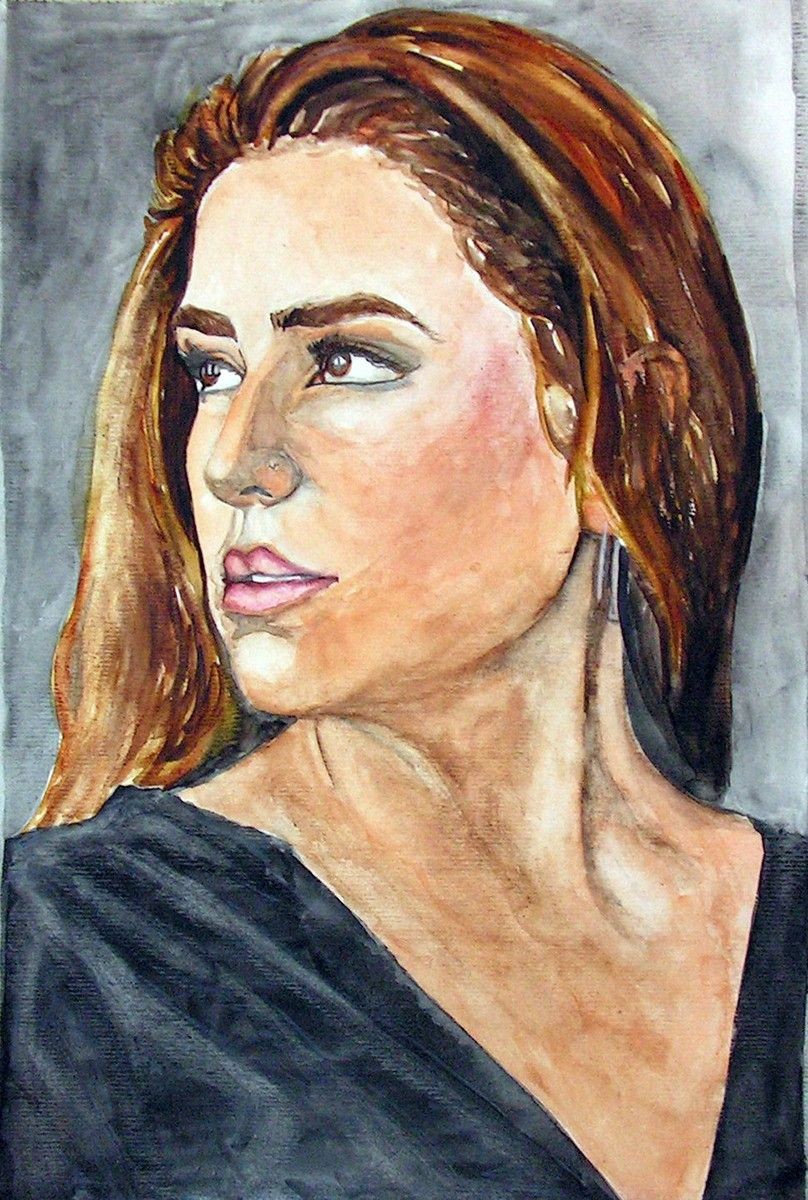
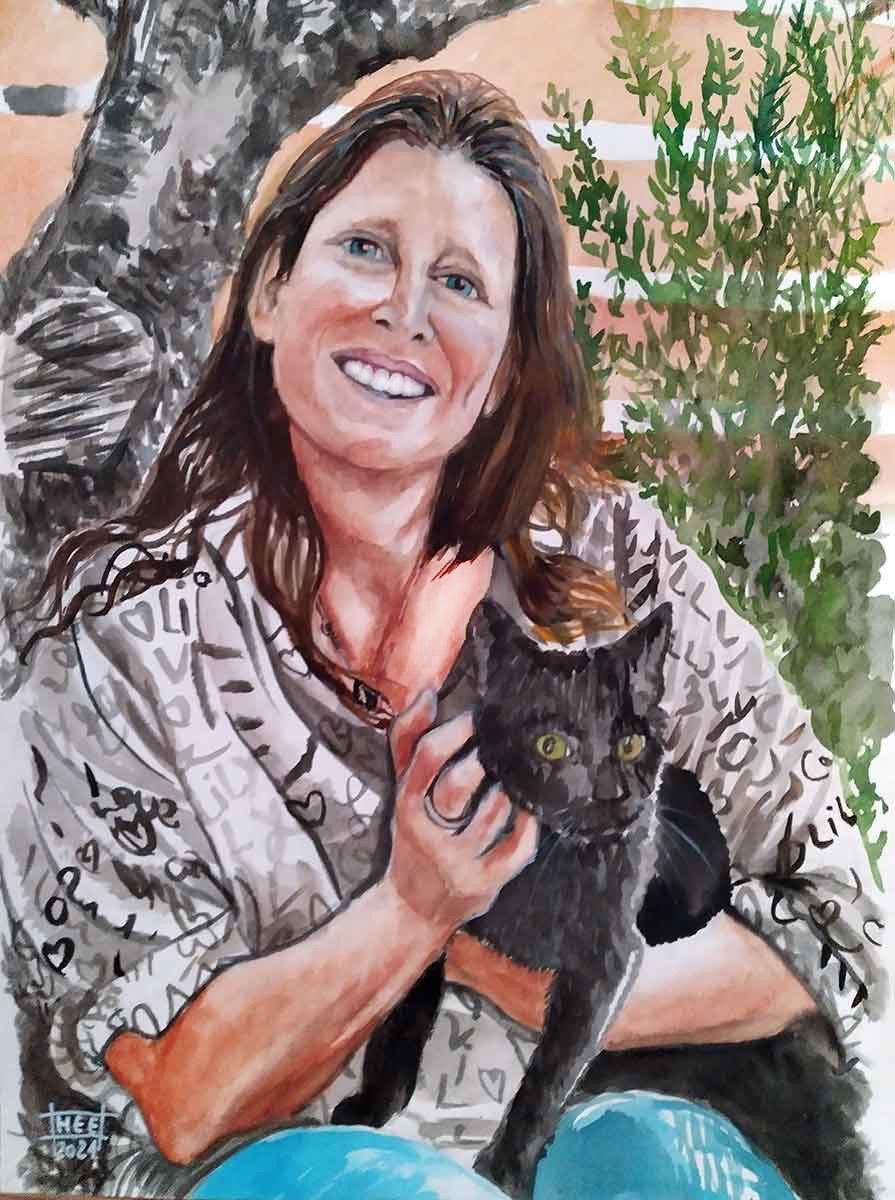
The gallery in this article shows eight watercolor portraits: a birthday present for a loved one, a gift for a spouse, two couple portraits, a gift for a Bar Mitzvah boy, a portrait with Grandpa, a memorial portrait of a beloved cat, and a romantic birthday gift that features a cat as well. One of the couple portraits was painted from an old photo as a golden wedding anniversary gift. To order, a photograph, new or old, is all you need. More paintings are waiting for you in the gallery of watercolor portrait paintings. Portraits of couples are the subject of the article Couple Portrait Painting.