


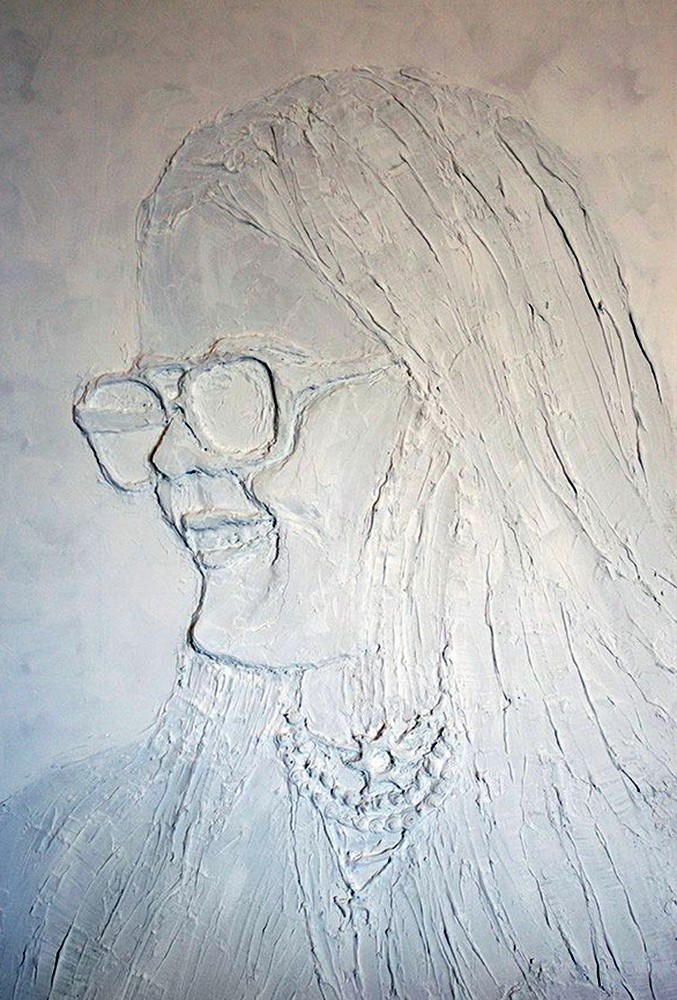
3D Relief Portrait: History and What Depth Adds
A 3D relief portrait is a portrait in which the face is modelled above the surface, or cut down into it, rather than painted on it. In sculpture the shallow form is called low relief; the form in which the outlines are cut into the surface is called sunk relief. The difference between a portrait of this kind and a flat painting is not one of style but of physics: a flat painting represents volume through painted shading, whereas in a relief the shadow is produced by the depth itself, and so it moves when the light moves.
The ancient Egyptians turned that fact into a working rule. Part of the Temple of Dendur, which stands today in the Metropolitan Museum of Art in New York, was carved in sunk relief, a technique that according to the museum created deep shadows in the bright sunlight. For the interior of the same building raised relief was used, in which the background is carved away around the figures. The choice between the two methods was not a matter of taste but of how much light the wall could expect to receive.
Those reliefs were brightly painted, and so were other temples in Egypt and across much of the ancient world. Almost nothing of that colour survives. When a team at the Metropolitan Museum set out to recover the colour of one wall at Dendur, it searched the wall for traces of pigment both with the naked eye and by visible-induced luminescence imaging, and found none; it therefore described the reconstruction it projected onto the wall as hypothetical only. What remains of ancient relief is the form, not the hue. That is also why, in a relief of one uniform tone, the form reads in full: depth and light do the work on their own.
The personal portrait entered relief very early. In the mastaba of Perneb, a palace administrator who built himself a limestone tomb at Saqqara, the painted reliefs show the owner of the tomb seated before an offering table, receiving food and other goods from relatives and retainers. On a small scale the portrait carried itself in stone. The cameo, in which the design is carved in relief, is according to the British Museum probably an invention of the royal Hellenistic court in Alexandria, and it served for imperial portraiture and propaganda as well. About engraved gems the museum adds a remark that is almost a display instruction: they are small, and they need to be seen closely, and with ample light.
In the Renaissance the form returned as the portrait medal. Pisanello's medal of John VIII Palaeologus, cast in bronze, is described by the Victoria and Albert Museum in London as probably the earliest surviving Renaissance portrait medal. According to the same museum, these two-sided medals, a form Pisanello developed, drew their inspiration from Roman coins excavated all over Italy. They commemorated individuals or events, and functioned as gifts and mementoes. Donatello also worked in marble in rilievo schiacciato, literally squashed relief, an extremely shallow relief that conveys a sense of depth by barely grazing the surface of the stone. Antonio Abondio was, according to the same museum, the first artist to make portrait medallions in wax, and during the eighteenth and nineteenth centuries low relief portraits in wax became popular in Britain; they were circulated like prints and medals, or served as personal mementoes.
What was a working rule for the Egyptians is an examination tool today. When conservators want to see the surface of a painting, they illuminate it from one side only and at an oblique angle to that surface. The National Gallery in London calls this raking light in its glossary, and describes how the raised areas of paint that face the light are lit while those facing away cast shadow, so that the texture of the painting's surface is revealed. Human perception works on the same principle: shading is an important monocular cue for seeing depth, and from the patterns of shading across an object the visual system infers its shape. A flat painting supplies that cue in paint; in a relief the cue is present in the material, and so the same work does not look the same in the morning as in the evening, nor when one walks past it.
And relief has a dimension that is not visual at all. The National Museum of Wildlife Art in Wyoming added to its gallery a tactile relief re-creating a work by the painter Robert Bateman, with Braille beside it and a narrative that opens at a touch, so that blind and visually impaired visitors meet the work with their hands.
The materials used for relief portraiture today are documented by their manufacturers. Golden's Molding Pastes are water-based products formulated with 100% acrylic polymer emulsions, and the solids in its regular Molding Paste are marble dust; Liquitex describes its Professional Modeling Paste as a 100% acrylic polymer and marble dust putty that builds form and structure. Golden adds, on its page about preparing a painting support, that thicker paintings require a sturdier support, and that in such a case a timber support may be in order. Which is also what one receives in a 3D relief portrait commissioned today: the shadow in it is not painted but produced, it changes with the light in the room and with where the viewer stands, and the depth is not only seen but can also be touched.
Would you like a 3D relief portrait of a person or an animal? Click here to order